If you have ever connected an LED directly to a battery or power supply and watched it burn out instantly, then you already understand why a current limiting resistor is important.
A current limiting resistor helps protect an LED from drawing too much current. Without it, the LED may overheat, fail permanently, or have a very short lifespan.
To make things easier, we created this free LED Current Limiting Resistor Calculator to help you quickly determine the correct resistor value for your LED circuit.
LED Current Limiting Resistor Calculator
Calculate the right resistor value, nearest standard resistor, and safe power rating for your LED circuit.
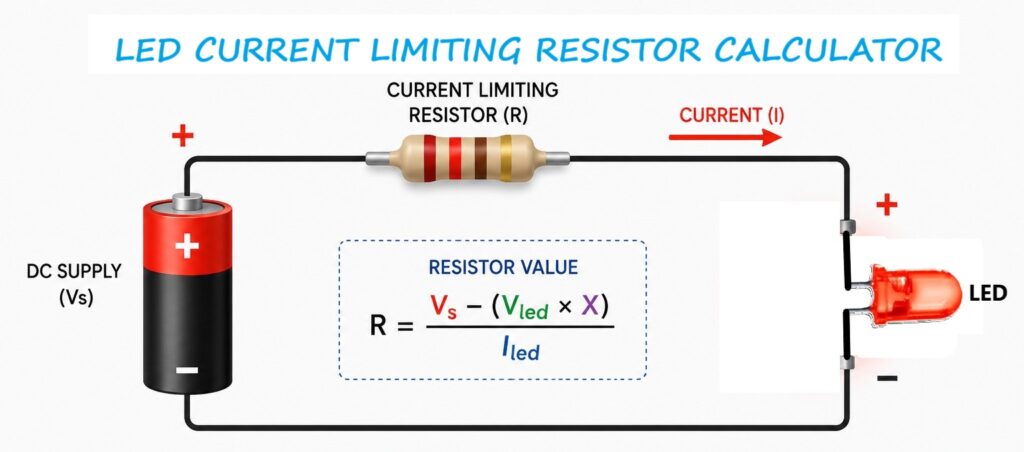
R is in ohms, Vs is supply voltage, Vled is LED voltage drop, X is number of LEDs in series, and Iled is LED current in amps.
Safety note: If the exact resistor value is not available, choose the next higher standard resistor value.
Use the nearest higher resistor value when the exact result is unavailable.
The calculator estimates resistor wattage and recommends a safer standard power rating.
The calculator subtracts the total LED voltage drop from the supply voltage.
What Is an LED Current Limiting Resistor?
An LED (Light Emitting Diode) current limiting resistor is a resistor connected in series with an LED to control the amount of current flowing through it.
Unlike incandescent bulbs, LEDs are current-sensitive electronic components. Even a small increase in current can damage them.
The resistor absorbs the excess voltage from the power supply and ensures the LED receives only the current it is designed to handle.
Why LEDs Need a Current Limiting Resistor
LEDs operate within a safe current range.
For example:
- Standard red LEDs usually operate around 20mA
- High-brightness LEDs may operate at higher currents
- Small indicator LEDs may require less than 20mA
If you connect an LED directly to a voltage source without limiting the current, the LED may:
- Burn instantly
- Become extremely hot
- Lose brightness
- Have reduced lifespan
- Damage other components in the circuit
Using the correct resistor prevents these problems.
Formula for LED Current Limiting Resistor
The formula used in this calculator is:
\[ R=\frac{V_s-(V_{led}\times X)}{I_{led}} \]
Where:
- R = Resistor value in ohms (Ω)
- Vs = Supply voltage
- Vled = LED forward voltage drop
- X = Number of LEDs connected in series
- Iled = LED current in amps
Understanding Each Parameter
1. Supply Voltage (Vs)
This is the voltage source powering the circuit.
Examples:
- 5V USB supply
- 9V battery
- 12V adapter
- 24V power supply
2. LED Forward Voltage (Vled)
This is the voltage drop across a single LED when operating normally.
Different LED colours usually have different forward voltages.
Typical values:
| LED Colour | Typical Forward Voltage |
|---|---|
| Red | 1.8V – 2.2V |
| Yellow | 2.0V – 2.2V |
| Green | 2.0V – 3.2V |
| Blue | 3.0V – 3.5V |
| White | 3.0V – 3.5V |
3. Number of LEDs in Series (X)
This refers to how many LEDs are connected one after another in series.
If you have:
- 1 LED → X = 1
- 3 LEDs in series → X = 3
- 5 LEDs in series → X = 5
4. LED Current (Iled)
This is the operating current of the LED.
Most standard LEDs operate at:
- 20mA (0.02A)
Some high-power LEDs may use:
- 350mA
- 700mA
- 1A or more
Example Calculation
Suppose you want to connect:
- Three red LEDs
- Each LED has a forward voltage of 2V
- Supply voltage is 12V
- LED current is 20mA
Using the formula:
\[ R=\frac{12-(2\times3)}{0.02} \]
Result:
\[ R=300\ \Omega \]
So the required resistor value is:
- 300Ω
You can use the nearest standard resistor value.
How to Choose the Nearest Standard Resistor Value
Sometimes the exact resistor value calculated may not exist.
In that case, choose the nearest higher standard resistor value.
For example:
| Calculated Value | Recommended Standard Value |
| 287Ω | 300Ω |
| 315Ω | 330Ω |
| 470Ω | 470Ω |
| 980Ω | 1kΩ |
Choosing a slightly higher resistor is safer than choosing a lower one.
How to Calculate Resistor Power Rating
The resistor also dissipates power as heat.
Power is calculated using:
P=I^2R
Where:
- P = Power in watts
- I = Current in amps
- R = Resistance in ohms
In most small LED circuits:
- 1/4W resistors are sufficient
For higher currents, you may need:
- 1/2W
- 1W
- 2W resistors
Common Mistakes When Using LEDs
1. Connecting LEDs Directly to Power
This is the most common beginner mistake.
Always use a resistor unless the LED module already includes one.
2. Using the Wrong LED Voltage
Different LED colours have different forward voltages.
Always check the LED datasheet if possible.
3. Mixing LEDs with Different Characteristics
When LEDs with different voltages are mixed in series, current distribution may become uneven.
4. Using Too Low Resistor Values
Lower resistor values increase current and may damage the LED.
Can You Use One Resistor for Multiple LEDs?
Yes — if the LEDs are connected in series.
However, for parallel LED connections, it is usually safer to use separate resistors for each LED branch.
Series vs Parallel LED Connections
LEDs in Series
Advantages:
- Same current flows through all LEDs
- More efficient
- Requires only one resistor
Disadvantages:
- If one LED fails open, all go off
LEDs in Parallel
Advantages:
- LEDs operate independently
Disadvantages:
- Current imbalance may occur
- Usually requires separate resistors
Applications of LED Current Limiting Resistors
These resistors are used in:
- Arduino projects
- ESP32 projects
- Indicator lights
- Automotive LED circuits
- Decorative LED strips
- DIY electronics projects
- Robotics projects
- Control panels
- Sign boards
Frequently Asked Questions (FAQ)
What happens if the resistor value is too low?
The LED may draw excessive current and burn out.
What happens if the resistor value is too high?
The LED will become dim because less current flows through it.
Can I use a potentiometer instead?
Yes, a potentiometer can vary LED brightness, but a fixed resistor is more stable for permanent circuits.
Why does my LED still get hot?
Possible reasons include:
- Excess current
- Wrong resistor value
- High-power LED without heatsink
- Incorrect wiring
Can this calculator be used for high-power LEDs?
Yes, but high-power LEDs often require proper current drivers and heatsinks.
Final Thoughts
Choosing the correct resistor for an LED is one of the most important basics in electronics.
Using the proper current limiting resistor helps:
- Protect LEDs
- Improve reliability
- Prevent overheating
- Extend LED lifespan
- Ensure stable brightness
Instead of calculating manually every time, you can use the LED Current Limiting Resistor Calculator above to get fast and accurate results for your projects.
If you found this calculator useful, check out our other electronics calculators and DIY electronics tutorials on Ettronics.