TOOLS
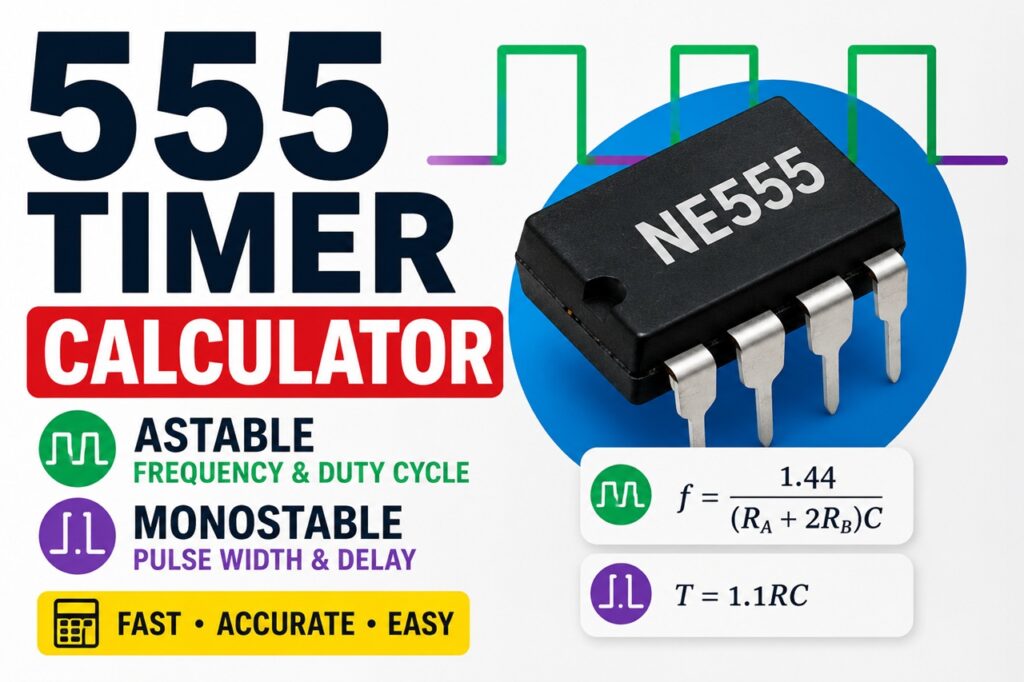
555 Timer Astable Calculator and 555 Timer Monostable Calculator – Complete Tool
If you’re looking for a reliable 555 timer astable calculator or 555 timer monostable calculator, you’ve come to the right place. The 555 timer IC is one of the most popular integrated circuits ever created, and it remains a cornerstone of electronics design for students, hobbyists, technicians, and professional engineers. From blinking LEDs and alarm circuits to pulse generators and delay timers, the 555 timer offers a simple and cost-effective solution for a wide range of applications. However, manually calculating frequency, duty cycle, pulse width, and timing component values can be tedious and prone to error. That’s where the Ettronics 555 Timer Calculator comes in. It automatically calculates all the important parameters for both astable and monostable configurations, helping you design accurate circuits faster. What Is a 555 Timer? The 555 timer is an eight-pin integrated circuit designed for generating precise timing signals. It can operate in different modes, but the two most commonly used are: In astable mode, the circuit continuously oscillates between HIGH and LOW states. In monostable mode, the circuit generates a single output pulse whenever it receives a trigger signal. Because of its simplicity, low cost, and reliability, the 555 timer continues to be used in countless electronic circuits worldwide. Common applications include: What Is a 555 Timer Astable Calculator? A 555 timer astable calculator is a tool used to determine the operating characteristics of a 555 timer configured as a free-running oscillator. In astable mode, the output continuously alternates between HIGH and LOW without requiring an external trigger. The calculator automatically computes: based on the selected resistor and capacitor values. How the Astable Mode Works In an astable configuration, the timing capacitor repeatedly charges and discharges through the resistor network. As the capacitor voltage rises and falls between the internal threshold levels of the 555 timer, the output switches state, producing a continuous square-wave signal. This behavior makes astable mode ideal for: 555 Timer Astable Formula The oscillation frequency depends on the values of: Frequency Formula Where: Period Formula Where: High Time Formula Low Time Formula Duty Cycle Formula The Ettronics 555 Timer Astable Calculator automatically performs these calculations and presents the results in user-friendly engineering units. Example Astable Calculation Suppose you select: The calculator instantly determines: without requiring manual calculations. Practical Uses of Astable Mode LED Blinkers Generate flashing LEDs for indicators and warning systems. Oscillators Create continuous square-wave signals for testing and timing. Clock Generators Provide timing pulses for counters and digital circuits. Alarm Circuits Generate repetitive signals for buzzers and sirens. Educational Demonstrations Help students understand capacitor charging and discharging behavior. What Is a 555 Timer Monostable Calculator? A 555 timer monostable calculator is used to calculate the pulse duration of a one-shot timer circuit. Unlike astable mode, a monostable circuit remains stable until triggered. When a trigger signal is applied: This makes monostable mode ideal for generating accurate delays. How the Monostable Mode Works In a monostable configuration: Because only one pulse is generated for each trigger, this configuration is often called a one-shot timer. 555 Timer Monostable Formula The pulse duration depends on the timing resistor and capacitor. Pulse Width Formula Where: The Ettronics 555 Timer Monostable Calculator instantly computes the pulse duration based on the selected component values. Example Monostable Calculation Suppose you choose: The pulse width becomes: Instead of performing these calculations manually, the calculator provides the result instantly. Astable vs Monostable Mode Feature Astable Mode Monostable Mode Trigger Required No Yes Output Continuous Oscillation Single Pulse Frequency Generation Yes No Delay Generation Limited Excellent LED Flashing Excellent Limited Oscillator Function Excellent No Pulse Generation Continuous One-Shot Why Use the Ettronics 555 Timer Calculator? The Ettronics Electronics Calculator platform provides much more than basic calculations. Real-Time Calculations Results update automatically as values are entered. Formula Display View the actual equations used for each calculation. Engineering Unit Conversion Convert values between: Circuit Schematics Visual diagrams help users understand circuit connections. Mobile-Friendly Interface Designed to work perfectly on phones, tablets, and desktop computers. Educational Explanations Learn how the calculations are derived while designing your circuit. Common 555 Timer Design Mistakes Choosing Extremely Large Capacitors Large electrolytic capacitors can introduce leakage errors. Using Very Small Resistor Values Low resistance values may overload the discharge transistor. Ignoring Power Supply Decoupling A 100 nF capacitor between VCC and GND helps improve stability. Leaving the Reset Pin Floating Pin 4 should typically be connected to VCC. Ignoring Duty Cycle Limitations Standard astable circuits cannot naturally produce a perfect 50% duty cycle without modifications. Understanding Duty Cycle Duty cycle describes the percentage of time the output remains HIGH during one complete cycle. The formula is: Where: This parameter is particularly important in oscillator and pulse generation applications. Who Should Use a 555 Timer Calculator? The calculator is ideal for: Whether you are designing a simple LED flasher or a complex timing circuit, accurate calculations help ensure reliable performance. Final Thoughts A dependable 555 timer astable calculator and 555 timer monostable calculator can significantly simplify the design process. Instead of manually solving equations, converting units, and checking calculations, the Ettronics 555 Timer Calculator provides instant results for frequency, duty cycle, pulse width, high time, low time, and timing component selection. By combining real-time calculations, engineering unit conversion, mathematical formulas, educational explanations, and circuit schematics, the calculator serves as both a practical design tool and a learning resource for anyone interested in electronics. Whether your goal is to build an oscillator, delay timer, pulse generator, or timing circuit, the Ettronics 555 Timer Calculator provides the accuracy and convenience needed to bring your design to life. See more Calculators:
Battery Runtime Calculator – Calculate Battery Life, Backup Time, Ah, Wh & kWh
Have you ever wondered how long your battery will last before it needs recharging? Whether you are designing a solar power system, sizing a battery bank for an inverter, building an electronics project, or planning backup power for a UPS system, knowing the expected battery runtime is essential. Our Battery Runtime Calculator helps you estimate battery life, backup time, battery energy, and runtime in hours, minutes, and days. It supports various battery technologies, including LiFePO4, lithium-ion, AGM, gel, and lead-acid batteries. What Is a Battery Runtime Calculator? A Battery Runtime Calculator is a tool used to estimate how long a battery can power a load before it becomes discharged. The calculator considers factors such as: By combining these parameters, the calculator provides a realistic estimate of how long your battery system can operate. Why Battery Runtime Matters Battery runtime calculations are important in many applications: Solar Power Systems Solar installers use battery runtime calculations to determine how long batteries can power appliances during periods of low sunlight. Inverter Systems Home and office inverter systems rely on battery banks for backup power. Knowing the expected runtime helps prevent unexpected outages. UPS Systems Businesses use UPS batteries to provide emergency power during blackouts. Accurate runtime estimates help determine whether the UPS can support critical equipment long enough for safe shutdown. Electronics Projects Engineers, technicians, hobbyists, and students frequently calculate battery life for Arduino, ESP32, Raspberry Pi, IoT devices, and portable electronics. Understanding Battery Capacity (Ah) Battery capacity is usually expressed in Ampere-hours (Ah). For example: A higher Ah rating generally means longer runtime, provided the load remains the same. Example A 100Ah battery can theoretically supply: However, real-world factors such as efficiency losses and depth of discharge affect actual runtime. Understanding Battery Voltage Battery voltage determines how much energy is stored. Common battery voltages include: The same Ah rating can provide very different energy storage depending on voltage. For example: The 24V battery stores twice as much energy. Battery Energy: Wh and kWh Battery energy is usually measured in: The formula is: Energy (Wh) = Voltage × Capacity (Ah) Example 12V × 100Ah = 1200Wh 1200Wh ÷ 1000 = 1.2kWh This means the battery stores approximately 1.2 kilowatt-hours of energy. How Battery Runtime Is Calculated The calculator uses the battery’s stored energy and compares it with the load power. Factors considered include: This provides a more realistic estimate than simple battery calculations. Battery Types Supported LiFePO4 Batteries LiFePO4 batteries offer: Recommended DOD: approximately 90% Lithium-Ion Batteries Lithium-ion batteries provide: Recommended DOD: approximately 80% AGM (Absorbent Glass Mat) Batteries AGM batteries are: Recommended DOD: approximately 50% Gel Batteries Gel batteries offer: Recommended DOD: approximately 50% Lead-Acid Batteries Traditional lead-acid batteries remain popular due to affordability and availability. Recommended DOD: approximately 50% What Is Depth of Discharge (DOD)? Depth of discharge indicates how much of the battery capacity is safely usable. For example: A 100Ah battery with 50% DOD provides approximately 50Ah of usable capacity. Using batteries beyond their recommended DOD can shorten lifespan significantly. What Is Inverter Efficiency? Inverter efficiency measures how effectively an inverter converts DC battery power into AC power. Typical values include: Higher efficiency means more battery energy reaches your appliances. Battery Runtime Example Suppose you have: The battery will provide several hours of backup power depending on the overall system efficiency and operating conditions. Our calculator performs these calculations automatically. Factors That Affect Battery Life Several factors influence actual runtime: Temperature Extreme temperatures reduce battery performance and lifespan. Battery Age Older batteries typically store less energy. Load Variations Appliances may consume more power during startup. Efficiency Losses Losses occur in: Battery Health Damaged or poorly maintained batteries often provide reduced runtime. Tips for Maximizing Battery Runtime Frequently Asked Questions How long will a 100Ah battery last? The answer depends on: A 100Ah battery powering a small load may last many hours, while a large load will reduce runtime significantly. What is the difference between battery life and battery runtime? Battery runtime refers to how long the battery can power a load during a single discharge cycle. Battery life refers to the overall lifespan of the battery over many charge-discharge cycles. Why is my actual runtime shorter than the calculated value? Possible reasons include: Are LiFePO4 batteries better for backup power? LiFePO4 batteries generally provide: They are often preferred for solar and inverter applications. Conclusion A reliable Battery Runtime Calculator helps you estimate backup time, battery life, battery energy, and power availability before installing or purchasing a battery system. Whether you are working with solar batteries, UPS systems, inverter batteries, LiFePO4 batteries, AGM batteries, gel batteries, or traditional lead-acid batteries, understanding runtime helps you make better engineering and energy-management decisions. Use the Ettronics Battery Runtime Calculator above to instantly estimate battery runtime, battery energy, and backup duration for your next project or power system. If you are into solar installations, you may want to check out our Solar System Sizing Calculator, it is the professional tool you need to make informed decisions when sizing solar panels, batteries, inverters, charge controllers, for your solar system installations.
Solar Panel Calculator– Calculate Solar Panels, Batteries, Inverter Size & ROI Accurately
If you’re planning to install a solar power system, one of the biggest questions you’ll face is: How many solar panels do I need? Closely followed by: The good news is that you don’t have to guess. Our Solar System Calculator helps you accurately estimate solar panel size, battery bank capacity, inverter size, charge controller rating, generator size, daily energy production, ROI, and payback period in just a few minutes. Whether you are building a small backup system for your home or designing a large off-grid solar installation, this calculator provides practical estimates that can help you plan your project with confidence. What Is a Solar System Calculator? A solar system calculator is a tool that estimates the major components required for a solar power system based on your energy consumption. Instead of manually performing multiple calculations, the calculator automatically determines: This makes it useful for homeowners, businesses, solar installers, engineers, students, and renewable energy consultants. Why Proper Solar System Sizing Is Important One of the most common mistakes people make is purchasing solar components without calculating their actual energy requirements. An undersized system may result in: An oversized system may result in: Proper sizing helps ensure that every component works efficiently and safely. How a Solar Power System Works A typical solar energy system consists of several major components: Solar Panels Solar panels convert sunlight into electrical energy. The amount of electricity generated depends on: Charge Controller The charge controller regulates power flowing from the solar panels to the batteries. Its job is to: Battery Bank The battery bank stores energy for use when sunlight is unavailable. This allows the system to operate: Inverter The inverter converts battery DC power into AC power used by household appliances. Common inverter sizes include: Generator (Optional) Many backup and hybrid systems include a generator for emergency charging during extended periods of poor weather. How to Calculate Daily Energy Consumption Before sizing a solar system, you need to know your daily energy usage. The formula is: Daily Energy (Wh) = Load Power (W) × Hours of Use Example Suppose you have: Daily Energy = 1000 × 5 = 5000Wh = 5kWh per day This value forms the foundation of the entire solar design process. How Solar Panel Size Is Calculated The calculator estimates the required solar array using your daily energy requirement and local sunlight conditions. Factors considered include: Example Daily Energy Requirement: 5kWh Peak Sun Hours: 5 hours Required Solar Array: Approximately 1.5kW to 1.7kW Using 550W solar panels: Required Panels: 3 Panels How Battery Bank Size Is Calculated Battery capacity depends on: Why Days of Autonomy Matter Days of autonomy represent the number of days the battery bank can power the system without solar charging. Typical values: Application Days of Autonomy Backup Systems 1 Day Residential Off-Grid 2 Days Remote Locations 3 Days or More Increasing autonomy improves reliability but increases battery cost. How Many Batteries Do I Need? The answer depends on: For example: Required Battery Bank: 24V 400Ah Available Batteries: 12V 200Ah Possible Configuration: 2 Batteries in Series × 2 Parallel Total Batteries: 4 The calculator automatically determines battery quantity and configuration. How Inverter Size Is Determined The inverter must be large enough to handle: A safety margin is usually added to the calculated load. For example: Load: 1000W Recommended Inverter: 1500W Pure Sine Wave This allows the inverter to handle surge currents safely. What Is Peak Sun Hours? Peak Sun Hours (PSH) represent the equivalent number of hours per day that sunlight reaches maximum intensity. Examples: Location Peak Sun Hours Lagos 5.0 Abuja 5.5 Kano 6.0 Port Harcourt 4.5 The calculator includes sunlight database options and manual input for flexibility. Solar Battery Calculator Features The built-in battery calculator supports: Lead Acid Batteries Advantages: Disadvantages: AGM (Absorbent Glass Mat) Batteries Advantages: Gel Batteries Advantages: Lithium LiFePO4 Batteries Advantages: For most modern installations, LiFePO4 batteries offer the best long-term value. Solar Inverter Calculator Features The inverter calculator helps determine: It supports: Battery Bank Calculator Features The battery bank calculator estimates: This helps users avoid undersized battery banks. Off-Grid Solar Calculator For off-grid systems, the calculator becomes even more valuable because it considers: Off-grid systems must be carefully sized because there is no utility grid available as a backup. ROI Calculator for Solar Systems The calculator can also estimate financial performance. By entering: You can estimate: This helps determine whether a solar project is financially worthwhile. AI-Powered Solar Recommendations One of the unique features of the Ettronics Solar System Calculator is the optional AI recommendation engine. The AI can provide: These recommendations help users better understand their results. Who Should Use This Solar Calculator? This tool is suitable for: Homeowners Planning backup or off-grid systems. Solar Installers Performing quick client estimates. Renewable Energy Consultants Generating preliminary system designs. Students Learning solar system design principles. Electrical Engineers Conducting preliminary feasibility assessments. Businesses Evaluating solar investment opportunities. Common Solar Sizing Mistakes Avoid these common mistakes: Underestimating Daily Energy Use Always calculate actual appliance usage. Ignoring Inverter Losses Inverters are not 100% efficient. Choosing Too Few Batteries Insufficient battery storage can reduce system reliability. Using Unrealistic Sunlight Values Use local peak sun hours whenever possible. Ignoring Future Expansion Leave room for future load growth. You can check out our Battery Runtime Calculator. Frequently Asked Questions How accurate is this solar system calculator? The calculator provides reliable preliminary estimates based on accepted solar sizing principles. Final installation designs should be verified by a qualified solar professional. Can I use this calculator for commercial projects? Yes. The calculator can be used for residential and commercial solar planning. Does the calculator work for lithium batteries? Yes. The battery module supports lithium battery calculations. What inverter size should I choose? Always select an inverter with sufficient margin above your expected load. Can this calculator determine wire size? The calculator can provide preliminary wire sizing guidance, but final cable selection must consider cable length, voltage drop, installation method, ambient temperature, and local electrical codes. Conclusion A properly sized
Voltage Divider Calculator – Calculate Output Voltage, Resistor Values & Divider Ratio
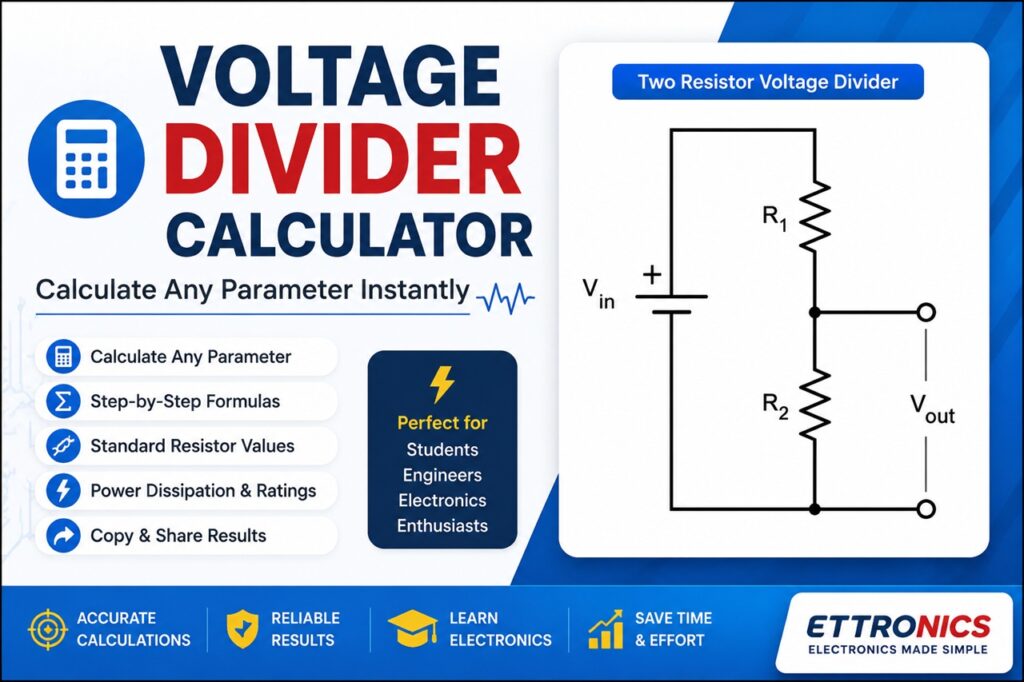
Voltage Divider Calculator helps you quickly determine the output voltage produced by two resistors connected in series. Instead of performing manual calculations, this tool can calculate the input voltage (Vin), output voltage (Vout), or resistor values (R1 and R2) required to achieve a desired voltage. Use the calculator below to instantly solve voltage divider problems and obtain accurate results. What Is a Voltage Divider? A voltage divider is a simple electronic circuit that uses two resistors connected in series to produce a lower voltage from a higher input voltage. The output voltage is taken from the junction between the two resistors. Voltage dividers are commonly used when a circuit requires a voltage level that is lower than the available supply voltage. For example: Voltage Divider Formula The voltage divider formula is: Vout=Vin×R2R1+R2V_{out}=V_{in}\times\frac{R_2}{R_1+R_2} Where: The formula shows that the output voltage depends on the ratio between the two resistor values. How to Use the Voltage Divider Calculator Using the calculator is straightforward: Step 1 Select what you want to calculate: Step 2 Enter the known values. Step 3 Select the appropriate units. Step 4 Click Calculate. Step 5 Review the results and recommendations. Example Voltage Divider Calculation Suppose: Applying the formula: Vout=12×500010000+5000V_{out}=12\times\frac{5000}{10000+5000} Result: Vout = 4V This means a 12V supply can be reduced to approximately 4V using these resistor values. Common Applications of Voltage Dividers Voltage dividers are used in countless electronic circuits. Sensor Interfacing Many sensors output voltages that must be scaled before entering a microcontroller. Examples: ADC Input Scaling Microcontrollers such as: often have voltage limitations on their analog inputs. Voltage dividers help reduce higher voltages to safe levels. Reference Voltage Generation Voltage dividers can create stable reference voltages for: Battery Monitoring Battery voltages frequently exceed the safe input range of ADC pins. Voltage dividers are commonly used to monitor battery levels safely. Advantages of Voltage Dividers Limitations of Voltage Dividers Although useful, voltage dividers have limitations. Load Effects Connecting a load to the output changes the effective resistance and may alter the output voltage. Not Suitable for High Current Loads Voltage dividers are intended for signal-level applications rather than powering devices. Reduced Accuracy Resistor tolerances affect output voltage accuracy. Using 1% resistors generally produces better results than 5% resistors. Common Voltage Divider Mistakes Using Incorrect Resistor Values Always verify resistor values before assembly. Ignoring Resistor Tolerance Resistors are not perfect and can vary from their nominal value. Forgetting Load Resistance The connected circuit can significantly affect the output voltage. Using a Voltage Divider as a Power Supply Voltage dividers are not designed to power heavy loads. Practical Design Tips Frequently Asked Questions What does a voltage divider do? A voltage divider reduces an input voltage to a lower output voltage using two resistors connected in series. Can a voltage divider increase voltage? No. A voltage divider can only reduce voltage. What happens if R1 equals R2? When R1 and R2 have the same value, the output voltage becomes half of the input voltage. Why is my measured output voltage different from the calculated value? Possible reasons include: Can I use a voltage divider with an Arduino or ESP32? Yes. Voltage dividers are commonly used to scale voltages for Arduino and ESP32 analog input pins. Final Thoughts A voltage divider is one of the most important circuits in electronics. Understanding how it works can help you design sensor interfaces, scale voltages for microcontrollers, generate reference voltages, and troubleshoot electronic circuits more effectively. Use the Voltage Divider Calculator above whenever you need to quickly determine Vin, Vout, R1, or R2 without performing manual calculations. Whether you are an electronics student, hobbyist, maker, technician, or engineer, voltage dividers are among the most frequently used circuits in electronic design. For more electronics tools, explore our growing collection of calculators and tutorials on Ettronics.
LED Current Limiting Resistor Calculator
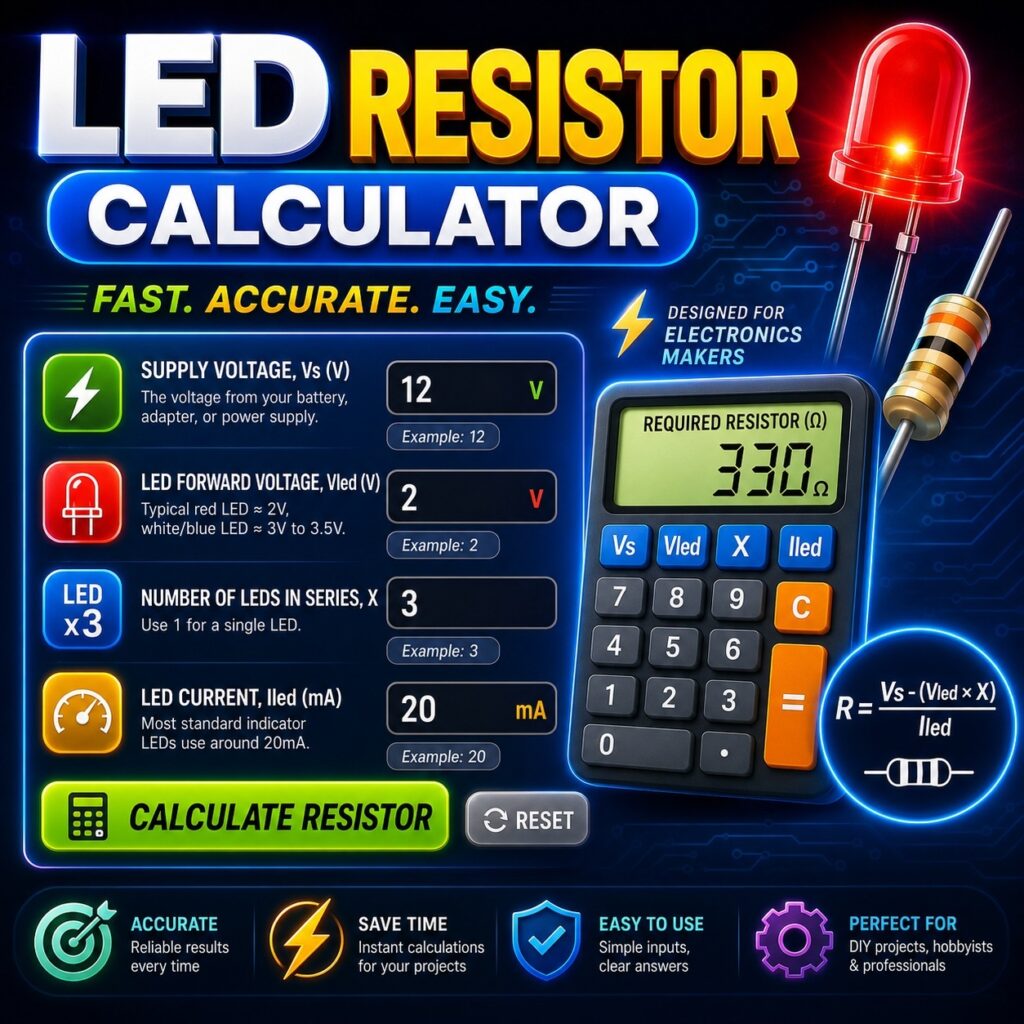
If you have ever connected an LED directly to a battery or power supply and watched it burn out instantly, then you already understand why a current limiting resistor is important. A current limiting resistor helps protect an LED from drawing too much current. Without it, the LED may overheat, fail permanently, or have a very short lifespan. To make things easier, we created this free LED Current Limiting Resistor Calculator to help you quickly determine the correct resistor value for your LED circuit. What Is an LED Current Limiting Resistor? An LED (Light Emitting Diode) current limiting resistor is a resistor connected in series with an LED to control the amount of current flowing through it. Unlike incandescent bulbs, LEDs are current-sensitive electronic components. Even a small increase in current can damage them. The resistor absorbs the excess voltage from the power supply and ensures the LED receives only the current it is designed to handle. Why LEDs Need a Current Limiting Resistor LEDs operate within a safe current range. For example: If you connect an LED directly to a voltage source without limiting the current, the LED may: Using the correct resistor prevents these problems. Formula for LED Current Limiting Resistor The formula used in this calculator is: \[ R=\frac{V_s-(V_{led}\times X)}{I_{led}} \] Where: Understanding Each Parameter 1. Supply Voltage (Vs) This is the voltage source powering the circuit. Examples: 2. LED Forward Voltage (Vled) This is the voltage drop across a single LED when operating normally. Different LED colours usually have different forward voltages. Typical values: LED Colour Typical Forward Voltage Red 1.8V – 2.2V Yellow 2.0V – 2.2V Green 2.0V – 3.2V Blue 3.0V – 3.5V White 3.0V – 3.5V 3. Number of LEDs in Series (X) This refers to how many LEDs are connected one after another in series. If you have: 4. LED Current (Iled) This is the operating current of the LED. Most standard LEDs operate at: Some high-power LEDs may use: Example Calculation Suppose you want to connect: Using the formula: \[ R=\frac{12-(2\times3)}{0.02} \] Result: \[ R=300\ \Omega \] So the required resistor value is: You can use the nearest standard resistor value. How to Choose the Nearest Standard Resistor Value Sometimes the exact resistor value calculated may not exist. In that case, choose the nearest higher standard resistor value. For example: Calculated Value Recommended Standard Value 287Ω 300Ω 315Ω 330Ω 470Ω 470Ω 980Ω 1kΩ Choosing a slightly higher resistor is safer than choosing a lower one. How to Calculate Resistor Power Rating The resistor also dissipates power as heat. Power is calculated using: P=I^2R Where: In most small LED circuits: For higher currents, you may need: Common Mistakes When Using LEDs 1. Connecting LEDs Directly to Power This is the most common beginner mistake. Always use a resistor unless the LED module already includes one. 2. Using the Wrong LED Voltage Different LED colours have different forward voltages. Always check the LED datasheet if possible. 3. Mixing LEDs with Different Characteristics When LEDs with different voltages are mixed in series, current distribution may become uneven. 4. Using Too Low Resistor Values Lower resistor values increase current and may damage the LED. Can You Use One Resistor for Multiple LEDs? Yes — if the LEDs are connected in series. However, for parallel LED connections, it is usually safer to use separate resistors for each LED branch. Series vs Parallel LED Connections LEDs in Series Advantages: Disadvantages: LEDs in Parallel Advantages: Disadvantages: Applications of LED Current Limiting Resistors These resistors are used in: Frequently Asked Questions (FAQ) What happens if the resistor value is too low? The LED may draw excessive current and burn out. What happens if the resistor value is too high? The LED will become dim because less current flows through it. Can I use a potentiometer instead? Yes, a potentiometer can vary LED brightness, but a fixed resistor is more stable for permanent circuits. Why does my LED still get hot? Possible reasons include: Can this calculator be used for high-power LEDs? Yes, but high-power LEDs often require proper current drivers and heatsinks. Final Thoughts Choosing the correct resistor for an LED is one of the most important basics in electronics. Using the proper current limiting resistor helps: Instead of calculating manually every time, you can use the LED Current Limiting Resistor Calculator above to get fast and accurate results for your projects. If you found this calculator useful, check out our other electronics calculators and DIY electronics tutorials on Ettronics.