Ettronics Electronics Calculator
Battery Life / Runtime Calculator
Estimate how long a battery or battery bank can power your load using voltage, Ah capacity, battery type, inverter efficiency, depth of discharge, remaining charge, safety margin, and optional Peukert correction.
About This Battery Life Calculator
This battery life calculator helps estimate how long a battery will last when powering DC loads, inverter loads, UPS loads, solar backup systems, routers, CCTV systems, LED lighting, Arduino projects, ESP32 projects, and other electronic devices.
The result is an estimate because real battery runtime depends on battery age, temperature, discharge current, cable losses, inverter losses, battery chemistry, depth of discharge, and the actual power consumption of the connected load.
Battery Type and Recommended Depth of Discharge
| Battery Type | Default DOD | Best Use |
|---|---|---|
| Lead Acid / Flooded | 50% | Inverter, UPS, solar backup |
| AGM | 50% | UPS, backup power, telecom |
| Gel | 50% | Solar and standby systems |
| Lithium-ion | 80% | Portable electronics, power stations |
| LiFePO4 | 90% | Solar, inverter, long-cycle backup |
Note: This calculator provides engineering estimates for planning purposes. Always confirm final battery sizing with manufacturer datasheets and site conditions.
Term Explanation
Have you ever wondered how long your battery will last before it needs recharging? Whether you are designing a solar power system, sizing a battery bank for an inverter, building an electronics project, or planning backup power for a UPS system, knowing the expected battery runtime is essential.
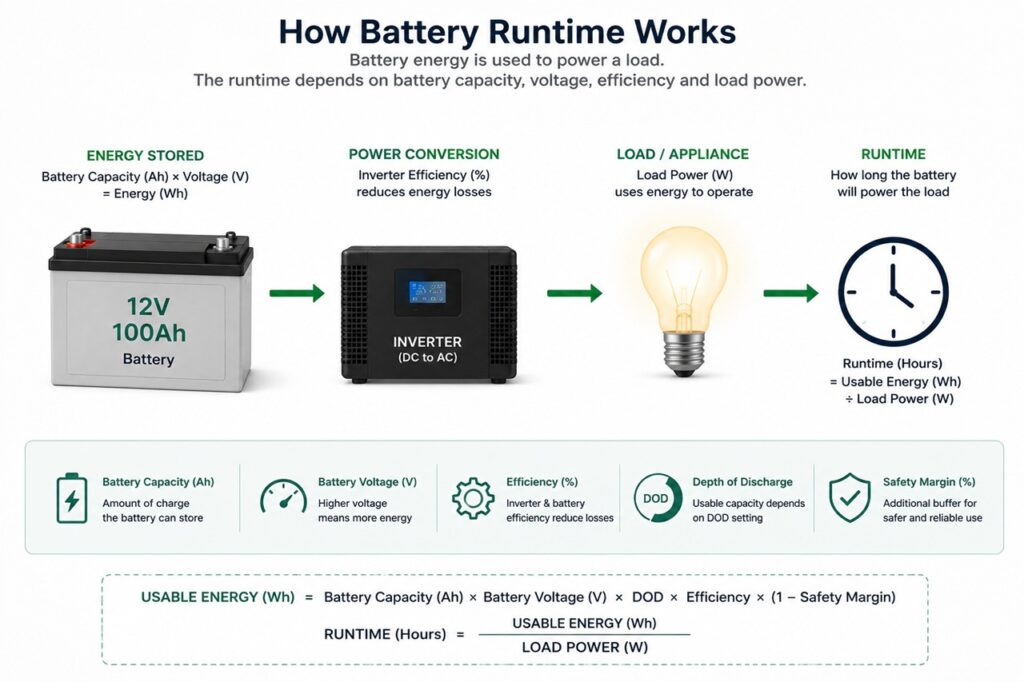
Our Battery Runtime Calculator helps you estimate battery life, backup time, battery energy, and runtime in hours, minutes, and days. It supports various battery technologies, including LiFePO4, lithium-ion, AGM, gel, and lead-acid batteries.
What Is a Battery Runtime Calculator?
A Battery Runtime Calculator is a tool used to estimate how long a battery can power a load before it becomes discharged.
The calculator considers factors such as:
- Battery voltage
- Battery capacity (Ah)
- Load power (W)
- Battery efficiency
- Inverter efficiency
- Depth of discharge (DOD)
- Battery configuration
- Safety margin
By combining these parameters, the calculator provides a realistic estimate of how long your battery system can operate.
Why Battery Runtime Matters
Battery runtime calculations are important in many applications:
Solar Power Systems
Solar installers use battery runtime calculations to determine how long batteries can power appliances during periods of low sunlight.
Inverter Systems
Home and office inverter systems rely on battery banks for backup power. Knowing the expected runtime helps prevent unexpected outages.
UPS Systems
Businesses use UPS batteries to provide emergency power during blackouts. Accurate runtime estimates help determine whether the UPS can support critical equipment long enough for safe shutdown.
Electronics Projects
Engineers, technicians, hobbyists, and students frequently calculate battery life for Arduino, ESP32, Raspberry Pi, IoT devices, and portable electronics.
Understanding Battery Capacity (Ah)
Battery capacity is usually expressed in Ampere-hours (Ah).
For example:
- 7Ah battery
- 20Ah battery
- 100Ah battery
- 200Ah battery
A higher Ah rating generally means longer runtime, provided the load remains the same.
Example
A 100Ah battery can theoretically supply:
- 10A for 10 hours
- 20A for 5 hours
- 5A for 20 hours
However, real-world factors such as efficiency losses and depth of discharge affect actual runtime.
Understanding Battery Voltage
Battery voltage determines how much energy is stored.
Common battery voltages include:
- 3.7V
- 6V
- 12V
- 24V
- 36V
- 48V
The same Ah rating can provide very different energy storage depending on voltage.
For example:
- 12V × 100Ah = 1200Wh
- 24V × 100Ah = 2400Wh
The 24V battery stores twice as much energy.
Battery Energy: Wh and kWh
Battery energy is usually measured in:
- Watt-hours (Wh)
- Kilowatt-hours (kWh)
The formula is:
Energy (Wh) = Voltage × Capacity (Ah)
Example
12V × 100Ah = 1200Wh
1200Wh ÷ 1000 = 1.2kWh
This means the battery stores approximately 1.2 kilowatt-hours of energy.
How Battery Runtime Is Calculated
The calculator uses the battery’s stored energy and compares it with the load power.
Factors considered include:
- Battery capacity
- Voltage
- Load power
- Efficiency losses
- Depth of discharge
- Safety margin
This provides a more realistic estimate than simple battery calculations.
Battery Types Supported
LiFePO4 Batteries
LiFePO4 batteries offer:
- Long cycle life
- High efficiency
- Deep discharge capability
- Fast charging
Recommended DOD: approximately 90%
Lithium-Ion Batteries
Lithium-ion batteries provide:
- High energy density
- Lightweight construction
- Good cycle life
Recommended DOD: approximately 80%
AGM (Absorbent Glass Mat) Batteries
AGM batteries are:
- Maintenance-free
- Reliable
- Common in UPS systems
Recommended DOD: approximately 50%
Gel Batteries
Gel batteries offer:
- Improved deep-cycle performance
- Reduced maintenance requirements
Recommended DOD: approximately 50%
Lead-Acid Batteries
Traditional lead-acid batteries remain popular due to affordability and availability.
Recommended DOD: approximately 50%
What Is Depth of Discharge (DOD)?
Depth of discharge indicates how much of the battery capacity is safely usable.
For example:
A 100Ah battery with 50% DOD provides approximately 50Ah of usable capacity.
Using batteries beyond their recommended DOD can shorten lifespan significantly.
What Is Inverter Efficiency?
Inverter efficiency measures how effectively an inverter converts DC battery power into AC power.
Typical values include:
- Modified sine wave: 80–90%
- Pure sine wave: 90–95%
Higher efficiency means more battery energy reaches your appliances.
Battery Runtime Example
Suppose you have:
- Battery Voltage: 12V
- Capacity: 100Ah
- Load: 150W
- DOD: 90%
- Efficiency: 90%
The battery will provide several hours of backup power depending on the overall system efficiency and operating conditions.
Our calculator performs these calculations automatically.
Factors That Affect Battery Life
Several factors influence actual runtime:
Temperature
Extreme temperatures reduce battery performance and lifespan.
Battery Age
Older batteries typically store less energy.
Load Variations
Appliances may consume more power during startup.
Efficiency Losses
Losses occur in:
- Inverters
- Wiring
- Connectors
- Battery chemistry
Battery Health
Damaged or poorly maintained batteries often provide reduced runtime.
Tips for Maximizing Battery Runtime
- Use high-efficiency appliances.
- Select high-efficiency inverters.
- Avoid excessive battery discharge.
- Maintain batteries properly.
- Keep batteries within recommended temperature ranges.
- Use correctly sized cables.
- Monitor battery health regularly.
Frequently Asked Questions
How long will a 100Ah battery last?
The answer depends on:
- Battery voltage
- Load power
- Efficiency
- Battery type
A 100Ah battery powering a small load may last many hours, while a large load will reduce runtime significantly.
What is the difference between battery life and battery runtime?
Battery runtime refers to how long the battery can power a load during a single discharge cycle.
Battery life refers to the overall lifespan of the battery over many charge-discharge cycles.
Why is my actual runtime shorter than the calculated value?
Possible reasons include:
- Low battery health
- High temperature
- Inverter losses
- Startup surges
- Battery aging
- Incorrect battery specifications
Are LiFePO4 batteries better for backup power?
LiFePO4 batteries generally provide:
- Higher efficiency
- Longer cycle life
- Greater usable capacity
- Faster charging
They are often preferred for solar and inverter applications.
Conclusion
A reliable Battery Runtime Calculator helps you estimate backup time, battery life, battery energy, and power availability before installing or purchasing a battery system.
Whether you are working with solar batteries, UPS systems, inverter batteries, LiFePO4 batteries, AGM batteries, gel batteries, or traditional lead-acid batteries, understanding runtime helps you make better engineering and energy-management decisions.
Use the Ettronics Battery Runtime Calculator above to instantly estimate battery runtime, battery energy, and backup duration for your next project or power system.
If you are into solar installations, you may want to check out our Solar System Sizing Calculator, it is the professional tool you need to make informed decisions when sizing solar panels, batteries, inverters, charge controllers, for your solar system installations.